
Mastery Part 4
Everything is becoming television, but some things are more resistant than others

“there were two areas of your life, essentially work and leisure, but now there are three; work, leisure and screentime, and…the screentime element tends to push out the active play which used to be a key part of the leisure time and replace it with a passive simulacra of play…”
In part 2 of this series I posited a sort of virtual simulation of play/leisure called ‘screentime’ which tends to take over the areas of life previously devoted to actual leisure time, and replace it with something less…leisurely.
In a recent article by Derek Thompson, writer at The Atlantic, called ‘Everything is Television’, the author makes a related observation.

He says:
By “television,” I am referring to something bigger than broadcast TV, the cable bundle, or Netflix. In his 1974 book Television: Technology and Cultural Form, Raymond Williams wrote that “in all communications systems before [television], the essential items were discrete.” That is, a book is bound and finite, existing on its own terms. A play is performed in a particular theater at a set hour. Williams argued that television shifted culture from discrete and bounded products to a continuous, streaming sequence of images and sounds, which he called “flow.” When I say “everything is turning into television,” what I mean is that disparate forms of media and entertainment are converging on one thing: the continuous flow of episodic video.
Reading this led me to refine my ideas a bit, as I realised what I was actually talking about was something a bit more defined than ‘screentime’. Actually, what was happening was that large chunks of internet usage have become simply vehicles for video ‘content’, and that even when I was a boy, this was happening in the form of TV, which was a less concentrated version of modern platforms like TikTok. My family, and I imagine most other families in the 80s, had the TV on all evening, most evenings, and it was simply there often as a soothing presence to ‘soak up’ bits of wandering attention, as Thompson puts it.
Now that streams of content can be viewed anywhere, we have a constant flow which drags attention outwards and diffuses it (see my fountain analogy in part 3).
So really, any media that is inherently bounded and discrete is more resistant to this process of transforming into ‘television’. That is why people who care about the hijacking of our attention are encouraging us to read books, because their boundedness means the process of reading is swimming against the flow of ‘content’.
Something important happens to us when we read books: ‘inwardness’ flourishes:
When literally everything becomes television, what disappears is not something so broad as intelligence (although that seems to be going, too) but something harder to put into words, and even harder to prove the value of. It’s something like inwardness. The capacity for solitude, for sustained attention, for meaning that penetrates inward rather than swipes away at the tip of a finger: These virtues feel out of step with a world where every medium is the same medium and everything in life converges to the value system of the same thing, which is television.
If there is anything I cherish that I have lost from my life, it is this feeling of inwardness and capacity for solitude that I used to have from reading books. I could go and lie on my bed as a teenager, and read for hours, feeling completely self-sufficient, engaged, not bored, in ‘flow’, but mentally stimulated, not zoned out.
Key to this capacity is the imagination. When attention is gathered and coherent, imagination can play. That inwardness that sees meaningfully within can lose its sight by the stream of images coming from without. Reading books, and to a certain extent writing, are the digging of those pools by which to catch the water of attention, and the act of digging itself is a kind of co-creation where the written word is received in the interior consciousness and becomes a story that you inhabit.
Imagination can be directed outward as well as inward of course. During play, from the earliest age, we are engaged in an imaginative co-creation with the world around us. As we grow, this play becomes formalised into games.
Games also help us to cultivate deeper, more coherent forms of attention. Part of the interest in board games (to the point where we’ve reached market saturation) lies in their being an antidote to the doomscroll. They involve real community, are participatory, physical, and require focused attention. Most of all, you have to play rather than just watch.
It struck me that play was the key thing that had been pushed out by everything becoming television. It’s not like this hadn’t been a concern when the only thing that was television was television! Parents telling their kids to go outside and play instead of staring at the goggle-box was a thing that happened when I was a kid too.
Play involves the imagination, and the deadening stream of images from everything becoming television was rendering it unproductive. And so we forgot how to play. Or did we?
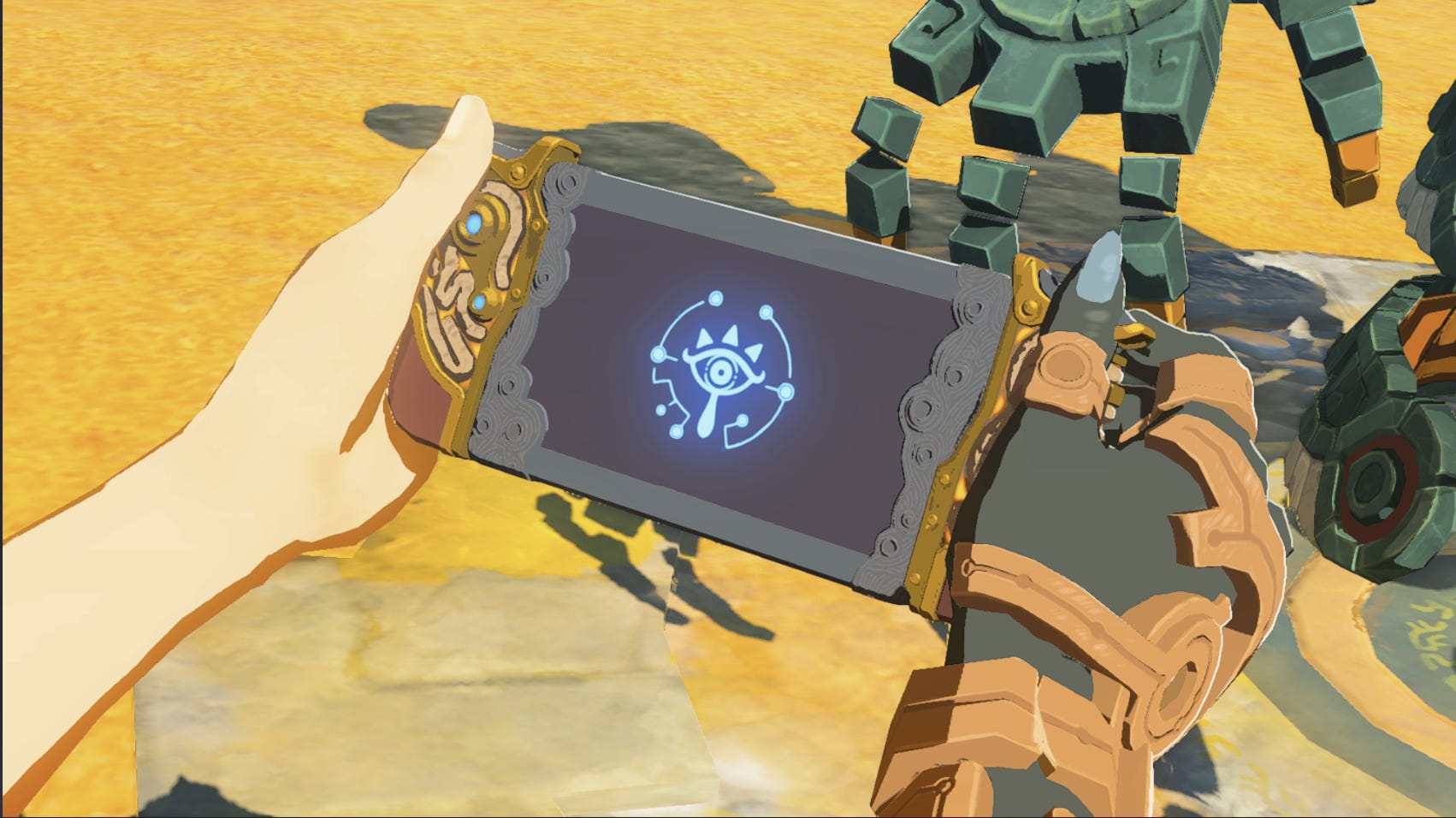
The Question of Video Games
If you ask most people what playing games means to them, if they don’t answer with a sport of some kind, they will probably talk about video games, either on PC, console, or handheld devices. For a long time video games got a worse rap than TV or phone-use, but things have changed over the last decade. Studies have shown a range of benefits, including improved hand-eye co-ordination, better mental health, and positive impacts on cognitive functions like memory and problem-solving.
Let’s be clear, there are no studies which show anything similar for other types of ‘screentime’ — television watching, social-media use, video and content watching on handheld devices are all fairly strongly correlated with negative mental and cognitive effects.
So gaming (playing video games) should be separated from other uses of screens, in the same way that reading on a Kindle or e-reader should be separated from scrolling on your phone and reading articles from X.
We can use Raymond Williams’ categories to understand why. Video games are interactive, and consist mainly of images generated out of pixels which are — in spite of the name — not video content (aside from cutscenes), but rather a representation of something that you have to manipulate or interact with in some way in order to succeed. Each game occupies a discrete space with its own rules and method to succeed. The passivity of the viewer of television or video content is not possible. You cannot succumb to the flow of episodic video. You must engage with a specific world and its rules, solve its puzzles, and learn how to navigate yourself in the game world.
This is not to say that video games are completely resistant to the erosion of this boundedness. The idea of a platform that you can do anything on is a key feature of a smartphone or a tablet, and it makes them susceptible to the slide into ‘television’. The sheer amount of choice tends to disrupt the calm focus we need to focus on one thing. And gaming devices with cloud access to any game can present the same dilemma for gamers. With so much to choose from, it becomes overwhelming.
Even so, if you go into your gaming session with a set of parameters such as limiting the type of game you will play to puzzle games, or cosy games, you can still get into that state of focused attention fairly easily.